Is a Webster pack the same as a blister pack?
Broadly yes. Blister pack is the general description; Webster pack is the name most Australians use. The formal term is dose administration aid.
 Medication Management · Australia
If you or someone you care for takes several medicines a day, a pharmacist may have suggested a Webster pack. It is one of the most useful things available for managing multiple medications, and one of the least well explained.
This guide covers what a Webster pack is, how to get one, what it costs, what can and cannot go into it, and the one thing it cannot do for you.
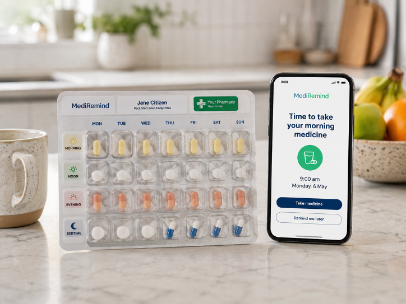
A Webster pack is a sealed card of medication prepared by your pharmacist, with your tablets and capsules already sorted by day and by time of day. The formal name is a dose administration aid, often shortened to DAA. Most people in Australia call them Webster packs regardless of which brand their pharmacy uses.
The card is usually laid out as a grid. Each row is a day of the week. Each column is a time of day, most commonly morning, midday, evening and night. Behind each sealed blister sits everything you are meant to take at that moment.
You press the tablets out through the foil when it is time. Because the blister is empty afterwards, you can see at a glance whether you have already taken that dose. That single feature is why pharmacists recommend them so often.
An empty blister shows a dose has been taken. A sealed blister shows it is still there. A helpful visual cue when days and medicines start to blur together.
Webster packs suit anyone who finds a row of bottles difficult to keep straight. That includes people taking four or more regular medicines, people whose doses change at different times of day, anyone with memory difficulties, and families where a son, daughter or carer helps manage medications from a distance.
They are also widely used in aged care and by people who have recently come out of hospital with a changed medication list.
A large share of Webster packs are managed by someone other than the person taking the medicines, usually an adult son or daughter, often living in another suburb or another state.
If you are in that position, a few things are worth knowing.
What a pack cannot give you is visibility. Unless you are in the room, you have no way of knowing whether this morning's blister is empty, or whether the next pack has been collected. That is the part carers find hardest, and it is the reason most families end up ringing to check.
Speak to your pharmacist. You do not need a referral, though your pharmacist will usually want to confirm your current list with your GP before preparing the first pack.
Bring everything with you, including medicines you buy without a prescription and anything a specialist has prescribed. The pack is only as accurate as the list it is built from, and the most common source of error is a medicine the pharmacist did not know about.
Allow a few days for the first pack. Once you are set up, packs are usually prepared weekly or monthly, and most pharmacies want two to three days' notice for each one.
This varies, and it is worth asking directly.
The Australian Government funds a Dose Administration Aids Program through the Community Pharmacy Agreement, which covers packs for eligible patients at participating pharmacies. It is a substantial programme, accounting for roughly half of all Community Pharmacy Agreement programme spending, and the number of patients each pharmacy can supply under it is capped.
In practice most pharmacies do charge community patients something, and a minority provide packs at no cost. Because both the subsidy and the pharmacy's own pricing vary, the only reliable answer is the one your own pharmacist gives you. Ask what the pack costs, whether you are eligible for the subsidised programme, and whether the price changes if you take more medicines.
The Dose Administration Aids Program is administered through the Pharmacy Programs Administrator under the 8th Community Pharmacy Agreement. The Australian Government Department of Health sets out the broader agreement and program context. Eligibility and fees still vary, so confirm the details with your pharmacist.
This is the part most people are not told, and it matters.
So almost everyone with a Webster pack also has medicines outside it. If you are helping someone manage their medications, the pack is not the whole picture, and assuming it is will eventually cause a missed dose.
When you collect a pack, check the label. It should show your name, the medicines inside, the dose times, and the dates the pack covers. If a tablet looks different from last time, ask before you take it. Generic brands change and the pharmacist can confirm in a moment.
Count the blisters against the days. A weekly pack with four time slots should have twenty-eight sealed blisters, though some slots may be legitimately empty if you take nothing at that time.
If your doctor changes a medicine partway through a pack, do not open the blisters and remove tablets yourself. Ring the pharmacy. They will usually prepare a replacement pack, and the old one should be returned rather than kept.
This is one of the genuine disadvantages of a pack: it is less flexible than bottles. It is also why telling your pharmacist about every change matters more than it would otherwise.
Webster packs travel well because everything is labelled and dated. Keep the pack in your hand luggage rather than checked baggage, carry it in its original card with the pharmacy label intact, and take a copy of your medication list.
For longer trips, ask the pharmacy well in advance. Preparing several weeks of packs takes time, and prescription supply rules may limit how far ahead you can be dispensed.
Keep the pack somewhere cool, dry and out of direct sunlight, and away from the bathroom. Somewhere you will see it at the right time of day is better than somewhere tidy.
A Webster pack tells you what to take and when it belongs. It can't remind you when that moment arrives.
It can sit perfectly organised on the kitchen bench while the morning gets busy and the dose is forgotten. The most common missed doses in well-organised households are not confusion about what to take. They are simply a moment that came and went.
The pack also cannot tell anyone else how you are going. A daughter in another suburb has no way of knowing whether this morning's blister is empty, or whether the next pack has been ordered.
That is the gap MediRemind was built to fill. It reminds you when each dose is due, keeps your eScripts and paper prescriptions together, counts your repeats down, and lets you manage a separate profile for each family member from one device if you would like to help someone else.
Australian owned, built in Perth. 30-day trial, then a subscription.
Broadly yes. Blister pack is the general description; Webster pack is the name most Australians use. The formal term is dose administration aid.
Yes. Speak to their pharmacist. You will usually need their consent and their current medication list.
Ask your pharmacist or doctor what to do for that particular medicine, as the answer differs. Do not double up without checking.
You can, but the empty blister then no longer tells you whether you have taken it, which removes much of the benefit.
Most pharmacies want two to three days. Ask yours and then set yourself a reminder.
Not automatically. The Australian Government funds a Dose Administration Aids Program for eligible patients at participating pharmacies, but eligibility, the number of patients each pharmacy can supply, and the pharmacy's own charges all vary. Most pharmacies charge community patients something. Ask your pharmacist whether you qualify for the subsidised programme and what the pack will cost you.
Yes. Your new pharmacy will need your current medication list and will usually confirm it with your GP before preparing the first pack, so allow a few days for the changeover and do not let your existing pack run out in the meantime.